Ambulatory Transportation in Emeryville & Oakland: Reliable Medical Rides

Getting a loved one from their front door to a medical appointment sounds simple. It isn't. For millions of seniors and patients managing chronic conditions, that short distance between home and clinic can feel overwhelming, especially when a rideshare driver shows up with no training, no patience, and no understanding of what medical fragility actually means. Professional ambulatory transportation exists precisely because that gap in care is real, and in the East Bay, it's a gap that families feel every single day.
You already know the anxiety. The 6:00 a.m. dialysis pickup that can't be late. The hospital discharge from a busy San Francisco facility where nobody seems to have a clear plan for getting your parent safely home. The quiet dread of trusting a stranger with someone you love. Those concerns are completely valid, and you deserve a service built around them rather than one that ignores them.
This guide covers everything you need to know about reliable medical rides across Emeryville, Oakland, and the greater East Bay, including what to expect from door-to-door assistance, how professional drivers support patients physically into clinics, and why the right transport partner gives families genuine peace of mind.
Key Takeaways
Professional ambulatory transportation is a specialized subset of NEMT designed for patients who can walk with or without aids — and understanding this distinction helps you book the right level of care from the start.
Standard rideshares like Uber and Lyft often leave medically fragile passengers without the trained support they need — learn why the gap between curb-to-curb and door-to-door service matters for your safety.
Knowing whether a passenger needs ambulatory or wheelchair transport comes down to a simple mobility assessment, and choosing correctly can make the entire medical trip smoother and safer.
Navigating complex discharge procedures at major hubs like Kaiser Permanente Oakland or UCSF Mission Bay requires a transportation partner who knows the logistics — not just the roads.
YESU NEMT has been serving Alameda County since 2022 as a compassionate, community-rooted partner — discover what sets their approach apart for seniors and patients across the East Bay.
Table of Contents What is Ambulatory Transportation? Defining NEMT in the East Bay Why Professional Assisted Transport Beats Standard Rideshares Ambulatory vs. Wheelchair Transport: Choosing the Right Level of Care Navigating Medical Centers in Oakland, Berkeley, and San Francisco Trust Every Step: Why YESU NEMT is the Alameda County Choice
What is Ambulatory Transportation? Defining NEMT in the East Bay
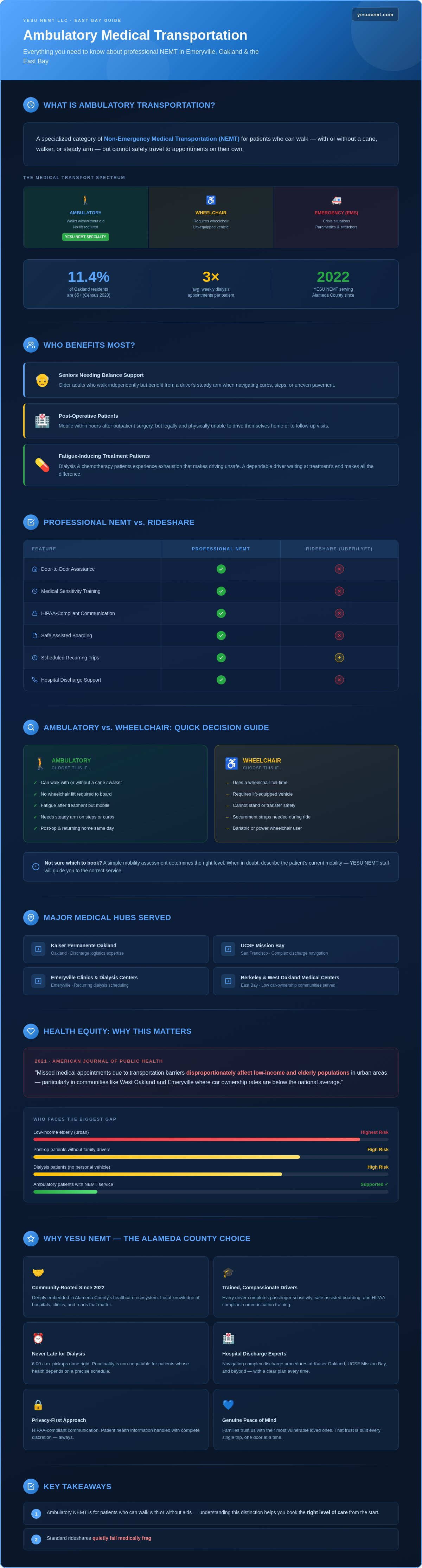
Not every medical trip requires an ambulance, and not every patient needs a wheelchair. For the thousands of Alameda County residents who can walk, perhaps with the help of a cane, walker, or a steady arm, ambulatory transportation fills a critical gap in the healthcare system. It's a specialized category of Non-Emergency Medical Transportation (NEMT) designed for patients who are mobile but cannot safely or reliably travel to medical appointments on their own.
NEMT itself is a broad category covering any scheduled, non-urgent medical transit. Within that category, ambulatory service is specifically reserved for passengers who are able to board and exit a vehicle without a wheelchair lift or stretcher. The distinction matters because it shapes the vehicle type, the driver's training, and the level of hands-on assistance a passenger receives during the trip.
Oakland's population is aging rapidly. According to the U.S. Census Bureau's 2020 data, approximately 11.4% of Oakland residents are aged 65 or older, a figure that continues to climb. For many in this group, the loss of a driver's license or the physical fatigue that follows a medical procedure doesn't mean they're wheelchair-bound; it simply means they need dependable, professional support to get from their front door to their doctor's office and back home safely.
Health equity is at the heart of why this service matters. A 2021 report from the American Journal of Public Health found that missed medical appointments due to transportation barriers disproportionately affect low-income and elderly populations in urban areas. In communities like West Oakland and Emeryville, where car ownership rates are lower than the national average, reliable ambulatory transportation isn't a luxury; it's a lifeline.
Ambulatory vs. Emergency Medical Services
Calling 911 is the right choice during a medical crisis: chest pain, a fall with injury, or a sudden neurological event. Ambulatory rides are scheduled in advance for stable, routine care. There are no sirens, no paramedics, and no stretchers involved. Think dialysis appointments every Tuesday, a follow-up with a cardiologist, or a post-surgical check-in at Kaiser Oakland. These are predictable, recurring needs that deserve a calm, professional, and timely solution.
Who Benefits Most from Ambulatory Rides?
The passengers who rely on this service most include:
Seniors needing balance support: Older adults who walk independently but benefit from a professional driver's steady arm when navigating curbs, steps, or uneven pavement.
Post-operative patients: Someone who has had outpatient surgery is often mobile within hours but legally and physically unable to drive themselves home or to follow-up visits.
Patients undergoing fatigue-inducing treatments: Dialysis patients, for example, attend sessions three times per week on average, and chemotherapy patients frequently experience exhaustion that makes driving unsafe. A compassionate, dependable driver waiting at the end of treatment makes all the difference.
Why Professional Assisted Transport Beats Standard Rideshares
Booking a rideshare for a medical appointment seems simple enough until the driver pulls up to the curb, waves from the window, and waits. For a patient recovering from hip surgery or managing advanced Parkinson's disease, that 15-foot walk from the curb to the entrance isn't a minor inconvenience. It's a genuine safety risk. Standard rideshare platforms like Uber and Lyft are built around curb-to-curb convenience, and that model works well for healthy passengers. It quietly fails medically fragile ones.
Professional ambulatory transportation providers operate on an entirely different standard. Drivers complete training in passenger sensitivity, safe assisted boarding techniques, and HIPAA-compliant communication, meaning they understand how to handle a patient's health information with discretion. They know not to discuss a passenger's condition in public spaces or within earshot of strangers. That level of professional conduct isn't a bonus feature; it's a baseline expectation.
Vehicle standards matter just as much as driver conduct. NEMT vehicles undergo regular sanitization protocols and safety inspections that go well beyond what a personal vehicle used for ridesharing would receive. Handrails, non-slip surfaces, and properly secured seating aren't optional extras in a compliant medical transport fleet. They're built into the vehicle specification from the start.
At YESU NEMT, this approach is reflected in a simple operating philosophy: trust every step of the way. That phrase isn't just a tagline. It describes a commitment to being present, reliable, and genuinely helpful at every point of a patient's journey, from the front door of their home to the check-in desk at their provider's office.
The Value of Door-to-Door Assistance
There's a meaningful difference between door-to-door and door-through-door service. Door-to-door means a driver arrives at your entrance and waits at the destination entrance. Door-through-door means the driver actively assists you inside, helps with check-in at a busy Oakland medical office, and ensures you're settled before leaving. For patients with mobility limitations or cognitive challenges, that extra step prevents falls, reduces anxiety, and removes the burden from already stretched clinic staff.
Reliability for Time-Critical Appointments
Dialysis patients, for example, cannot simply reschedule. Missing or arriving late to a treatment session carries real clinical consequences. Professional NEMT providers who serve the East Bay study local traffic patterns along corridors like I-880 and Telegraph Avenue to build realistic arrival windows. Advanced scheduling removes the anxious uncertainty of wondering whether a ride will appear. When you schedule your medical ride with YESU NEMT, that confirmation isn't just a booking; it's a dependable commitment backed by local knowledge and professional accountability.
Ambulatory vs. Wheelchair Transport: Choosing the Right Level of Care
One of the most common questions families ask when arranging a medical ride is simple but critical: does my loved one actually need a wheelchair-accessible van, or will ambulatory transportation work just as well? The answer depends on a specific clinical assessment, not a general assumption about age or diagnosis.
The key question is whether the passenger can independently pivot their body and lower themselves into a standard vehicle seat, even with the help of a grab bar or a driver's steadying arm. If the answer is yes, ambulatory service is typically the appropriate and more cost-effective choice. A patient recovering from a knee replacement who walks slowly with a cane, for example, doesn't automatically require a specialized wheelchair van. Matching the right level of service to the passenger's actual mobility avoids unnecessary complexity and keeps scheduling straightforward.
There's a persistent misconception that Non-Emergency Medical Transportation (NEMT) is reserved exclusively for people who cannot walk at all. That's simply not accurate. A significant portion of NEMT passengers are ambulatory individuals who need reliable, supervised transport because driving themselves is unsafe, not because they're completely immobile. Seniors managing chronic conditions, post-surgical patients, and individuals attending weekly dialysis treatments all benefit from professional ambulatory rides.
Equipment handling is another practical consideration. Ambulatory vehicles routinely accommodate:
Standard walkers and rollators, stored securely in the trunk or cargo area
Single-point and quad canes, kept within easy reach during the ride
Foldable transport wheelchairs, which collapse flat and don't require a ramp-equipped vehicle
A full power wheelchair or a non-collapsible scooter, by contrast, requires a wheelchair-accessible van with a hydraulic lift. Knowing the difference before booking saves time and ensures the right vehicle arrives at the door.
When to Transition from Ambulatory to Wheelchair Service
Three clear indicators signal that a higher level of assistance is needed: the passenger can no longer bear their own weight for more than a few steps, a physical therapist or physician has recommended a wheelchair for all transport, or a recent fall history makes unassisted transfers a documented safety risk. YESU NEMT manages both ambulatory and wheelchair-accessible needs, so families in Alameda County don't have to coordinate with multiple providers when a passenger's mobility changes after surgery or rehabilitation. A simple call to update the service level is all it takes.
Safety Protocols for Walking Passengers
Professional drivers assisting ambulatory passengers follow a consistent protocol. For high-profile vehicles like vans, the driver positions a step stool, offers a stable forearm grip (never a hand-clasp pull), and waits until the passenger is fully seated before closing the door. For low-profile sedans, the driver guides the passenger to back up to the seat edge first, reducing the risk of a forward stumble. Mobility aids are secured with hook-and-loop straps or placed in the trunk in a fixed position so they don't shift during transit. Throughout the journey, a dependable driver monitors the passenger's comfort, ensuring every ride reflects the smooth and pleasant experience that safety and well-being demand.
Navigating Medical Centers in Oakland, Berkeley, and San Francisco
The East Bay and San Francisco medical corridor is one of the busiest healthcare networks in Northern California. For patients traveling to Kaiser Permanente Oakland Medical Center on Broadway, Alta Bates Summit in Berkeley, or UCSF Mission Bay across the Bay Bridge, the logistics alone can feel overwhelming before a single appointment even begins. Knowing the exact drop-off zones, patient entrance locations, and parking constraints at each facility isn't optional; it's the difference between a smooth arrival and a stressful scramble.
At Kaiser Permanente Oakland, for example, the main patient drop-off on Broadway operates under strict time limits during peak hours. Drivers unfamiliar with the facility often circle the block, adding unnecessary stress to a patient who may already be anxious. A locally knowledgeable ambulatory transportation provider eliminates that uncertainty entirely, arriving at the correct entrance, on time, every time.
San Francisco hospital trips carry their own layer of complexity. One-way discharge rides from UCSF Mission Bay back to Emeryville or Oakland require coordination well in advance, since Bay Bridge traffic can add 30 to 45 minutes to an otherwise straightforward journey during afternoon peak hours. Families relying on rideshare apps for these trips frequently report delays and last-minute cancellations, leaving discharged patients waiting in hospital lobbies.
Hospital Discharge: The Critical Transition
Discharge day is arguably the most stressful moment in any hospital stay. A patient may be fatigued, on new medications, and uncertain about what comes next. Coordinating pickup times with nursing staff and discharge planners at facilities like Alta Bates Summit requires real communication, not just an app notification. Our drivers don't wait at the curb; they come inside, assist with belongings, and ensure the patient is safely settled inside their front door before leaving.
Recurring Rides for Dialysis and Rehab
Dialysis patients typically require three rides per week, every week, often for years. That kind of consistency demands more than reliability; it demands familiarity. When a patient sees the same dependable driver Monday, Wednesday, and Friday, it builds genuine trust that reduces anxiety over time. For long-term rehabilitation visits at East Bay clinics, familiar drivers also learn each facility's unique entry protocols and accessible parking locations, shaving valuable minutes off every trip.
Pre-scheduled recurring pickups eliminate the need to rebook after every appointment
Familiar drivers reduce patient anxiety during long-term treatment schedules
Local knowledge of clinic entrances and accessible parking speeds up every arrival
Reliable ambulatory transportation isn't just a convenience for these patients; it's a clinical necessity. Missing a dialysis session carries serious health consequences, which is why a worry-free schedule isn't a luxury. It's essential care.
Ready to set up dependable rides to Kaiser Oakland, Alta Bates, UCSF, or your local dialysis center? Schedule your recurring medical transportation with YESU NEMT today and travel with confidence, every single trip.
Trust Every Step: Why YESU NEMT is the Alameda County Choice
Choosing a medical transportation provider is never just a logistical decision. For seniors managing chronic conditions, patients recovering from surgery, and families coordinating care across multiple facilities, it's a decision rooted in trust. Since 2022, YESU NEMT has served the Emeryville and Oakland communities with a single, unwavering commitment: to be the dependable neighbor you can count on when medical appointments can't wait and reliability isn't optional.
What separates YESU NEMT from a standard ride service is the understanding that ambulatory transportation is part of a larger healthcare journey. Every pickup, every assist to the door, every timely arrival at a dialysis center or rehabilitation clinic is a moment where professional standards and genuine human empathy have to work together seamlessly. That's the standard YESU NEMT holds itself to, every single day.
Our Professional Standards and Empathy
Safety and well-being aren't talking points here; they're the foundation every ride is built on. YESU NEMT drivers are trained to assist passengers with a calm, patient presence that reflects what the brand calls the "Reliable Caregiver" approach. Expect punctuality, respectful communication, and door-to-door assistance that goes well beyond simply driving from one address to another.
YESU NEMT is proud to be a trusted community partner for Alameda County residents who deserve compassionate, professional medical transportation they can depend on, ride after ride.
That local focus matters. Knowing the specific routes between Oakland's Highland Hospital, the Kaiser Permanente facilities in Emeryville, and the network of outpatient clinics throughout Alameda County means less time in transit and more peace of mind for passengers and their families.
Booking Your Journey with YESU NEMT
Scheduling a ride is straightforward. To ensure a smooth experience, have the following details ready when you reach out:
Pickup address and preferred departure time
Destination medical facility, including the department or clinic name if applicable
Mobility aid information, such as whether the passenger uses a cane, walker, or rollator
Any special needs, including appointment duration for return-trip coordination
Providing these details upfront allows the YESU NEMT team to match the right vehicle and driver to your specific situation, eliminating last-minute surprises on the day of your appointment. Whether you're booking for yourself or coordinating care for a loved one, the process is designed to be simple, clear, and stress-free.
Reliable ambulatory transportation shouldn't be hard to find. Schedule your professional ambulatory transport with YESU NEMT today and experience the difference that a compassionate, community-rooted team makes from the very first ride.
Your Next Medical Appointment Deserves a Ride You Can Count On
Getting to and from medical care shouldn't add stress to an already demanding day. Ambulatory transportation isn't just a ride; it's a professional, door-to-door service built around your safety and well-being. As this article has shown, not all medical transport is created equal. Choosing a dedicated NEMT provider over a standard rideshare means trained drivers, HIPAA-compliant protocols, and the kind of patient, unhurried assistance that seniors and recovering patients genuinely need.
YESU NEMT has been serving Alameda County and San Francisco since 2022, connecting patients to Oakland, Berkeley, and San Francisco medical centers with dependable, compassionate care on every trip. Whether you're scheduling dialysis, a rehabilitation visit, or a hospital discharge, the right support makes all the difference.
Don't leave something this important to chance. Book your compassionate ambulatory ride with YESU NEMT today and take the next step in your healthcare journey with confidence. You deserve a team that's with you every step of the way.
Frequently Asked Questions About Ambulatory Transportation in Emeryville & Oakland
What is the main difference between ambulatory and wheelchair transportation?
Ambulatory transportation is designed for passengers who can walk independently or with minimal assistance, using mobility aids like canes, walkers, or crutches, while wheelchair transportation is specifically equipped with lifts and securement systems for passengers who remain seated in a wheelchair throughout the ride. Both are specialized non-emergency medical transport (NEMT) services, but they serve distinct mobility needs. Choosing the right service ensures your comfort and safety from pickup to drop-off.
If you're unsure which service fits your situation, our team is happy to walk you through the options. A quick conversation about your current mobility level helps us match you with the right vehicle and the right level of support.
Do you provide door-to-door assistance for seniors in Oakland?
Yes, we provide genuine door-to-door assistance, meaning our drivers come directly to your front door, help you to the vehicle safely, and escort you to the entrance of your destination. This goes well beyond standard curb-to-curb service. For seniors navigating steps, uneven walkways, or simply managing a medical bag and a walker at the same time, that hands-on support makes a real difference.
Our drivers are trained to move at your pace, never rushing you. Whether your appointment is at Highland Hospital, Kaiser Oakland, or a specialist's office on Broadway, you can trust every step of the way that someone is there beside you.
Can I book ambulatory transport for a hospital discharge in San Francisco?
Yes, we do serve hospital discharge trips to and from San Francisco, including facilities like UCSF Medical Center and Zuckerberg San Francisco General. Ambulatory transportation for a hospital discharge requires a bit more coordination than a routine appointment ride, so we recommend notifying us of the expected discharge window as early as possible, ideally 24 to 48 hours in advance.
Our drivers understand that discharge timing can shift. We stay in contact with you or your care team on the day of discharge so we're ready when you are, not sitting in a waiting room stressing about your ride home.
How far in advance should I schedule my medical ride in Emeryville?
We recommend booking at least 24 hours in advance for routine medical appointments in Emeryville and the broader Alameda County area. For same-day requests, availability depends on our schedule, so earlier contact always gives you a better chance of securing a confirmed ride. Recurring appointments, like weekly physical therapy or monthly specialist visits, can be pre-scheduled in a single call to lock in your preferred times.
Planning ahead removes the stress of last-minute logistics on a day when your focus should be on your health, not your ride. Our scheduling team is straightforward to reach, and confirming your booking takes just a few minutes.
Are your drivers trained to assist patients with walkers or canes?
Yes, all of our drivers are professionally trained to assist passengers who use walkers, canes, or other ambulatory aids. This includes helping you navigate curbs, steps, and doorways, steadying you as you enter or exit the vehicle, and making sure your mobility equipment is stored securely during the ride. Safety and well-being are the foundation of every trip we provide.
Our training goes beyond basic driving. Drivers are specifically prepared to work with older adults and patients recovering from procedures, which means they know when to offer a steady arm and when to simply give you the space and time you need to move comfortably.
Is ambulatory transportation covered by insurance or is it private pay?
Coverage depends on your specific insurance plan. Medi-Cal, for example, does cover non-emergency medical transportation (NEMT) for eligible California beneficiaries when the trip is medically necessary and pre-authorized. Medicare Advantage plans also frequently include NEMT benefits, though coverage rules vary by plan. We strongly recommend calling your insurer directly to confirm your benefits before your first trip.
For passengers without applicable coverage, private pay is available. We don't publish rates here, but our team can provide clear pricing information when you call to book. There are no hidden fees, and we'll make sure you understand the cost before your ride is confirmed.
What happens if my medical appointment in Berkeley runs late?
If your appointment runs over schedule, don't worry. Our drivers monitor your pickup window and will wait for a reasonable period without charging you a penalty for typical delays. We know that clinic wait times are unpredictable; a 2 p.m. appointment at a Berkeley medical office can easily run 30 to 45 minutes past the scheduled time.
If you anticipate a significantly longer delay, a quick call or text to our dispatch team helps us adjust your return pickup accordingly. We'd rather accommodate a schedule change than leave you standing outside a clinic trying to arrange an alternative ride. Our goal is a smooth, dependable experience from start to finish.
Do you offer recurring transportation for dialysis patients in Alameda County?
Yes, recurring ambulatory transportation for dialysis patients is one of our most requested services across Alameda County. Dialysis treatments typically run 3 times per week, and we can set up a standing schedule so you're not rebooking every single trip. Consistent, reliable pickup times matter enormously for dialysis patients, and we take that responsibility seriously.
We serve dialysis centers throughout Oakland, Emeryville, Berkeley, and the surrounding Alameda County communities. Once your recurring schedule is established, our team tracks it proactively. You'll have a dependable ride waiting for you, every session, without the added burden of coordinating logistics when you're already managing a demanding treatment routine.


Comments