The Complete Guide to Non-Emergency Medical Transport (NEMT) in 2026

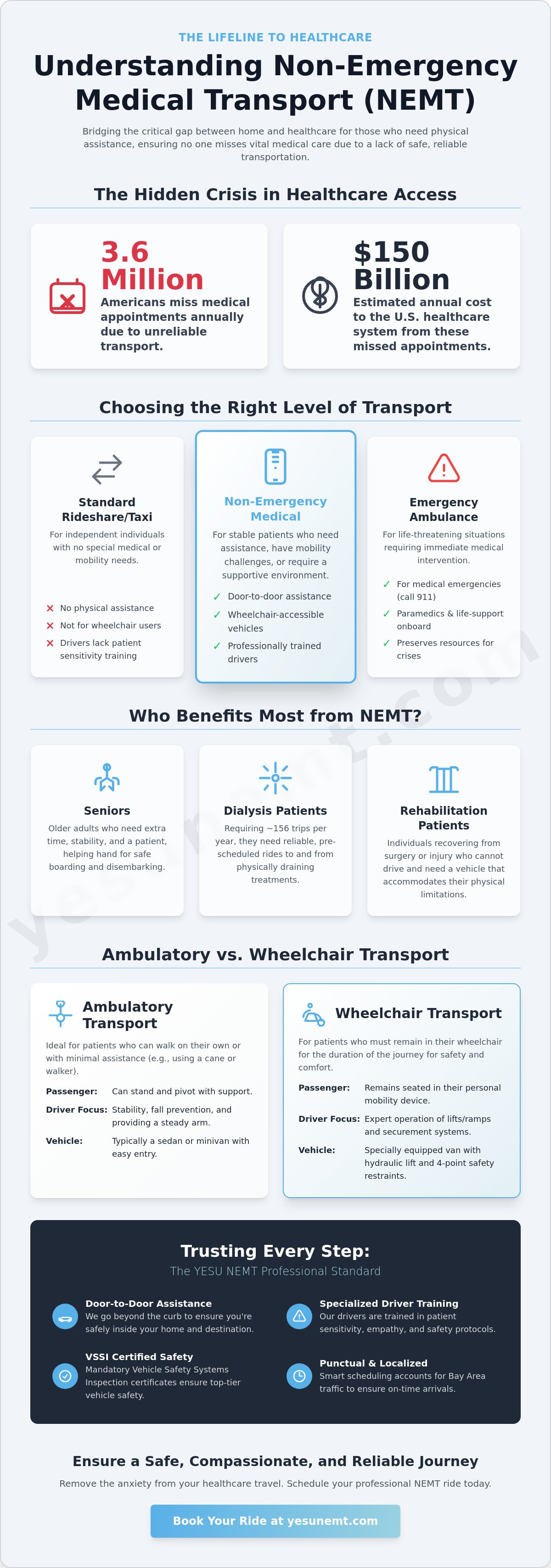
Did you know that 3.6 million Americans miss their medical appointments every single year because they lack reliable transportation? This gap in care costs the U.S. healthcare system an estimated $150 billion annually. For a patient waiting for life-sustaining dialysis, the cost is much more personal. Professional non-emergency medical transport bridges this gap. It offers more than just a ride. It provides a vital lifeline for those who need physical assistance and clinical precision during their most vulnerable moments.
We know the anxiety of watching the clock before a treatment or the stress of navigating a hospital discharge alone. You deserve to feel safe and supported every step of the way. This guide explains how professional NEMT ensures safety, reliability, and peace of mind for your healthcare journeys. You'll learn about the latest 2026 California regulations, including the mandatory Vehicle Safety Systems Inspection (VSSI) certificates, and see how a compassionate driver can transform a difficult trip into a smooth, pleasant journey that prioritizes your well-being.
Key Takeaways
Learn why professional non-emergency medical transport serves as a specialized bridge between home and healthcare for those who require dedicated physical support.
Identify the specific vehicle features and safety securement systems required to safely accommodate wheelchair-bound passengers during their journey.
Discover why specialized driver training and empathy make NEMT a more reliable and compassionate choice than standard rideshare services.
Learn how localized scheduling accounts for Bay Area traffic to ensure you arrive punctually for life-sustaining dialysis or rehabilitation appointments.
Explore how door-to-door assistance and a focus on your well-being can remove the anxiety from navigating complex hospital discharges.
Table of Contents
Understanding Non-Emergency Medical Transport (NEMT): More Than Just a Ride
Professional non-emergency medical transport is a specialized service designed for patients who don't require the immediate, life-saving intervention of an ambulance but cannot safely use standard transportation like buses or rideshare apps. It's more than just getting from point A to point B; it's a structured part of your medical plan. Unlike a standard taxi, this service provides a bridge between home and the clinic, focusing on physical stability and emotional reassurance. By moving the industry standard from simple curb-to-curb drop-offs to comprehensive door-to-door assistance, we ensure that the most vulnerable members of our community aren't left to navigate hospital hallways or steep driveways alone. This hands-on approach is what transforms a simple ride into a dependable care experience where you can trust every step of the way.
We don't provide sirens, stretchers, or paramedics. Instead, we offer a calm environment and professional drivers trained in patient sensitivity. This distinction is vital for the integrity of Patient transport services that support the broader healthcare continuum. For those managing chronic conditions, NEMT isn't just a convenience. It's a critical component of their treatment plan that reduces the risk of missed appointments and health complications. Our commitment to safety and well-being means we treat every passenger as a person, not just a line item in a logistics schedule.
Who Benefits from Specialized Medical Transport?
Many individuals find that standard transit doesn't meet their physical or medical requirements. Those who benefit most include:
Seniors: Older adults often need extra time and physical stability during boarding. A patient, professional hand makes a world of difference for those with limited mobility.
Dialysis Patients: These treatments are physically draining. With dialysis patients requiring approximately 156 trips every year, they need a reliable, pre-scheduled return trip where they don't have to wait in the cold while fatigued.
Rehabilitation Patients: Whether recovering from surgery or a stroke, these individuals can't drive themselves. They require a vehicle that accommodates their current physical limitations while they regain their independence.
NEMT vs. Emergency Ambulances: When to Call Which
Choosing the right level of care is essential for your safety and your wallet. Non-emergency medical transport is built for stable, scheduled appointments such as consultations, physical therapy, or routine check-ups. It's a proactive choice for your health. However, if you experience chest pain, severe bleeding, or a loss of consciousness, you must call 911 for an emergency ambulance. Using NEMT for non-urgent needs is a smart, cost-saving strategy. It preserves emergency resources for those in immediate crisis while providing you with a comfortable, professional alternative that understands your specific medical needs.
Ambulatory vs. Wheelchair Transport: Which Service Level Do You Need?
Selecting the correct level of non-emergency medical transport is a decision that impacts both the comfort and the physical safety of the passenger. It isn't merely a choice between a sedan and a van. It's a choice about the level of assistance required at the start and end of the trip. While ambulatory services cater to those who can walk with minor assistance, wheelchair services are for those who must remain in their mobility device for the duration of the transit. Understanding these distinctions helps families ensure their loved ones receive the appropriate care for their specific medical condition.
The core differences between these levels involve both vehicle hardware and specialized driver training. Ambulatory drivers focus on stability and fall prevention, while wheelchair transport drivers must be experts in mechanical securement and lift operation. By matching the service level to the patient's physical ability, we ensure a smooth and pleasant journey that avoids unnecessary strain or risk during the transition from the home to the vehicle.
Criteria for Choosing Wheelchair-Accessible Vans
Professional wheelchair-accessible vans are equipped with heavy-duty hydraulic lifts or ramps designed to handle various weight capacities. This is essential for passengers using specialized power chairs, which often weigh over 300 pounds. In 2026, California's Vehicle Safety Systems Inspection (VSSI) regulations ensure that every lift and securement system meets rigorous standards. Safety is our top priority, which is why these vehicles utilize 4-point securement protocols. These tie-downs lock the chair's frame into the vehicle's floor, preventing any shifting during turns or stops. Our drivers are trained to assist with these systems and navigate building ramps, providing a level of care that goes far beyond a standard curb-to-curb drop-off.
The Benefits of Assisted Ambulatory Transportation
Ambulatory transportation is designed for individuals who are mobile but may be frail, medicated, or recovering from surgery. It's about providing the "arm-through-arm" support that prevents falls on uneven pavement or steep stairs. This service is ideal for post-surgical patients who can walk but lack the physical strength to manage a long hospital corridor alone. A professional driver won't just leave you at the curb. They ensure you're safely checked into your appointment before they depart, acting as a compassionate partner in your healthcare journey. If you are unsure which level of care is right for your situation, our team can help you select the most dependable transportation option for your needs.
This "door-to-door" assistance is a primary signature of professional care. It distinguishes our service from standard taxis or rideshare apps where drivers aren't permitted to leave their vehicles. For a senior in Alameda County navigating a busy medical campus, having a steady, reliable hand to lean on makes the entire experience much less overwhelming. We care about your well-being beyond the drive, ensuring you feel secure every step of the way.
Why Professional NEMT Outperforms Standard Medical Taxis
A common question families ask is why they should invest in professional non-emergency medical transport when a standard taxi or rideshare app is just a few taps away. It's a valid concern. However, for a patient recovering from surgery or a senior with limited mobility, the difference isn't just about the vehicle. It's about the standard of care. Standard taxis operate on a volume-based model where speed is the priority. In contrast, NEMT is built on clinical precision and empathy. We understand that a medical journey requires a different level of accountability than a trip to the grocery store.
Every driver undergoes rigorous background checks and drug screenings that far exceed the requirements of standard transportation apps. This isn't just about safety; it's about reliability. When you book a ride for a dialysis treatment in Alameda County, you can't afford a driver who cancels at the last minute because the trip is too short. Professional NEMT providers prioritize your schedule, ensuring a dependable arrival that respects the time-sensitive nature of medical care. Additionally, our vehicles follow strict sanitation protocols. While a standard taxi might carry a variety of passengers and allergens throughout the day, our medical transport vehicles are cleaned with medical-grade disinfectants to protect passengers with compromised immune systems.
Safety Standards and Driver Training
Professional standards in 2026 require CPR and first-aid certification as a baseline for all NEMT staff. This provides a safety net that a standard taxi driver simply cannot offer. Beyond technical skills, our professionals receive aging-sensitivity training. This ensures they understand the unique needs of seniors, such as the need for a slower pace or clearer communication. For more details on selecting the right provider, see our guide on Choosing the Best Non Emergency Transport Service in Emeryville & Oakland (2026). This training ensures every passenger enjoys a smooth and pleasant journey.
The "Door-to-Door" Difference in Patient Care
Standard rideshare services are strictly "curb-to-curb." This is often insufficient for hospital discharge transportation where a patient may be weak or disoriented. We provide true door-to-door assistance. This means helping a patient from their living room, through the front door, and safely into the vehicle. This level of support significantly reduces caregiver burnout. Family members no longer have to worry about the physical labor of transit. Instead, they can focus on their loved one's recovery while we handle the logistics. It's about ensuring safety and well-being from the moment we arrive until the passenger is safely inside their destination. We want you to trust every step of the way.
Navigating Local Healthcare Logistics in Alameda County and San Francisco
SF Bay Area traffic isn't just a nuisance; it's a significant barrier to consistent medical care. For patients in Oakland or Alameda, a simple trip across the bridge to a specialist in San Francisco can vary by 40 minutes depending on the time of day. Professional non-emergency medical transport providers account for these variables by using local expertise and real-time traffic monitoring. We don't just follow a GPS; we understand the rhythm of the MacArthur Maze and the specific congestion patterns near the Caldecott Tunnel. This local knowledge allows us to schedule pickups that ensure a punctual arrival, alleviating the fear of being late for life-sustaining treatments.
Large medical campuses like Kaiser Permanente in Oakland or UCSF in San Francisco present their own set of challenges. These facilities are often sprawling complexes with multiple entry points and restricted discharge zones. A "local hero" provider knows the exact door where a patient will be waiting, whether it's at a rehabilitation center in Berkeley or a dialysis clinic in Emeryville. We coordinate directly with these centers to ensure a seamless handoff. This level of coordination is a primary signature of our service, as it prevents the confusion and physical strain of a patient waiting at the wrong entrance. We believe that your safety and well-being depend on this attention to detail, ensuring you feel supported every step of the way.
Coordinating with Major Bay Area Medical Centers
Navigating the busy discharge zones at regional hospitals requires patience and precision. These areas are often crowded with delivery vehicles and emergency services, making it difficult for standard cars to find a safe spot. Our drivers are familiar with the specific parking protocols at major Bay Area medical centers, which allows for a smooth transition from the hospital bed to the vehicle. For a deeper look at navigating our local network, see our Non-Emergency Medical Transportation Services in Emeryville & Oakland: A Complete Guide (2026). We ensure that every hospital discharge is handled with the clinical precision you deserve.
Scheduling and Lead Times for Recurring Appointments
To ensure a dependable and timely pickup, we recommend the "two-day rule." Booking your transport at least 48 hours in advance allows us to dedicate a vehicle and driver specifically to your needs. This is especially critical for dialysis appointment transportation, where missing a session can have serious health consequences. We understand that medical schedules can be unpredictable, particularly during a hospital discharge. A local partner offers the flexibility to handle last-minute changes that a national broker might miss. If your discharge time shifts unexpectedly, our team works to adjust your ride in real-time. You can schedule your medical transportation today to secure a partner who truly knows the neighborhood streets of Alameda County.
Trusting Every Step: The YESU NEMT Professional Standard
While many providers treat non-emergency medical transport as a simple logistics puzzle, we view it as a sacred trust. At YESU NEMT, we aren't just moving passengers; we're supporting our neighbors during their most sensitive moments. Choosing a transport partner is a deeply personal decision for families in Alameda County. You aren't just looking for a vehicle with a lift. You're looking for a professional who understands that a ten-minute delay could disrupt a vital medical treatment. Our "Reliable Caregiver" approach ensures that every interaction is grounded in empathy and clinical precision. We prioritize your safety and well-being as our top priorities, ensuring that the emotional weight of medical transit is lifted from your shoulders.
The end-to-end care experience begins the moment you contact us. We don't just take a reservation; we listen to your specific needs. Whether it's a wheelchair-accessible ride for a senior or ambulatory support for a post-surgical patient, we map out every detail. This comprehensive planning provides families with a sense of quiet confidence. You can rest easy knowing that your loved one is in the hands of a compassionate partner who knows the local streets of Oakland as well as their own. From the first greeting at your door to the final drop-off at your destination, we're committed to making the process as smooth as possible. It's this dedication that allows our passengers to trust every step of the way.
Our Commitment to Professionalism and Empathy
We treat every passenger like a member of our own Alameda County community. In our neighborhood, punctuality isn't just a business goal; it's a requirement for maintaining the efficacy of medical treatments. When a driver arrives on time, it reduces the patient's anxiety and sets a positive tone for the entire appointment. We've seen how a calm, pleasant journey can transform a stressful day into a manageable one. By focusing on the human element of non-emergency medical transport, we bridge the gap between clinical care and home recovery. We care about your health as much as your destination, providing a steady hand when you need it most.
How to Book Your Reliable Ride with YESU NEMT
Booking your next journey is a straightforward process designed to minimize stress for busy caregivers. We specialize in both ambulatory and wheelchair transportation throughout Emeryville, Oakland, and the surrounding SF Bay Area. Our team is ready to coordinate your dialysis appointments, rehabilitation visits, or hospital discharges with the care they require. For those specifically seeking specialized equipment and door-to-door assistance, you can learn more about our Wheelchair Transportation Emeryville CA: Safe & Reliable Medical Rides 2026. By choosing a local partner, you're ensuring that your transportation is handled by experts who are deeply invested in the health and happiness of our community.
Take the First Step Toward Stress-Free Medical Transit
Reliable healthcare shouldn't stop at the hospital exit. As the global non-emergency medical transport market grows toward an estimated $18.19 billion by late 2026, the industry focus is shifting away from simple transit and toward comprehensive care. You've seen how specialized wheelchair-accessible vehicles and trained professionals outperform standard taxis by prioritizing safety and well-being. Whether you're coordinating a hospital discharge or managing 156 annual dialysis trips, the right partner makes all the difference. We provide the door-to-door assistance and local Alameda County expertise that ensures you never have to worry about a missed appointment or an unsafe transition again.
Your journey deserves a compassionate hand and a driver who understands your specific medical needs. We're here to provide quiet confidence for your family and a smooth, pleasant experience for every passenger. Schedule your compassionate medical ride with YESU NEMT today and experience the professional standard you deserve. Let us help you navigate the Bay Area's complex logistics so you can focus entirely on your recovery. We're ready to support you and your loved ones with dependable care that lets you trust every step of the way.
Frequently Asked Questions
Is non-emergency medical transport covered by insurance or Medicare?
Medi-Cal covers non-emergency medical transport when a physician provides a Physician Certification Statement (PCS) confirming that your medical condition prevents the use of standard transit. While original Medicare Part B often excludes these costs, many 2026 Medicare Advantage plans now include transportation as a supplemental benefit. It's best to contact your specific insurance provider 48 hours before your trip to verify your current coverage and any required authorizations.
How far in advance should I book a ride for a dialysis appointment?
We recommend booking your ride at least 48 hours in advance to guarantee a dedicated vehicle for your treatment time. Since dialysis patients require approximately 156 trips per year, we often set up recurring schedules for our clients. This proactive approach ensures a punctual arrival for every session and removes the stress of coordinating multiple rides each week while you're managing your health.
What is the difference between curb-to-curb and door-to-door service?
Curb-to-curb service ends at the sidewalk, but our door-to-door assistance means the driver helps you from inside your home directly to your clinic's check-in desk. This hands-on support is essential for seniors or those recovering from surgery who can't navigate uneven pavement or heavy hospital doors alone. We prioritize your safety and well-being by ensuring you're never left to manage the physical transitions of your journey by yourself.
Can a family member or caregiver ride along with the patient?
One family member or authorized caregiver is welcome to ride with the patient to provide emotional support or assist with medical paperwork. Having a familiar face can significantly reduce the anxiety often associated with hospital discharges or complex rehabilitation visits. We believe that a pleasant journey involves the comfort of your loved ones, so we accommodate one companion at no extra cost whenever possible.
Are your vehicles equipped to handle heavy motorized wheelchairs?
Our specialized vans feature hydraulic lifts designed to safely handle heavy motorized wheelchairs with weight capacities often reaching 800 to 1,000 pounds. These lifts are regularly inspected under the 2025 California Vehicle Safety Systems Inspection (VSSI) standards to ensure mechanical reliability. We utilize 4-point securement protocols to lock your power chair into the vehicle's floor, providing a stable and secure ride through the streets of Alameda County.
What happens if a medical appointment runs longer than expected?
If your appointment is delayed, simply call our local dispatch team as soon as you realize the schedule has shifted. Because we're a local provider, we have the flexibility to adjust your return pickup in real-time. We understand that medical consultations are often unpredictable, and we work closely with clinic staff to ensure you have a dependable ride home once your treatment is finally complete.
Do you provide transportation for hospital discharges on weekends?
We provide professional medical transportation for hospital discharges seven days a week, including weekends and holidays. Many healthcare facilities continue discharging patients on Saturdays and Sundays, and we're committed to being a reliable caregiver for the community during those times. Our team coordinates directly with discharge planners at major Bay Area medical centers to ensure your transition home is smooth and well-managed.
How do you ensure the safety and sanitation of your vehicles?
We maintain the highest professional standards by cleaning every vehicle with medical-grade disinfectants after each passenger trip. This protocol is vital for protecting passengers with compromised immune systems or chronic conditions. Additionally, our fleet meets the rigorous 2025 California safety requirements, ensuring every mechanical system is in peak condition. You can trust every step of the way because we treat your health and safety as our top priorities.


Comments